Part 1
Most discussions of liability start with the famed case of the snail in the bottle; Donoghue v Stevenson [1932]. In this case a Mrs Donoghue drank a bottle of ginger beer that contained a decomposed snail, became ill, and sued the manufacturer of the beverage successfully. In reaching its conclusion, the court successfully introduced the concept of duty of care to English Law. Lord Atkin:
“You must take reasonable care to avoid acts or omissions which you can reasonably foresee would be likely to injure your neighbour. Who, then, in law, is my neighbour? The answer seems to be – persons who are so closely and directly affected by my act that I ought reasonably to have them in contemplation as being so affected when I am directing my mind to the acts or omissions which are called in question.”
Arguably the next major development in this area of the law came in Anns v Merton [1977]. This time a council had ‘neglected’ to ensure that the foundations of a building were sufficient and a two stage test was proposed, where after reasonable proximity of the parties is established, and it is reasonable that damage to the damaged could be expected to occur, a default or ‘prima facie’ duty of care arises, which can then be negatived by other factors. Indeed the Lord Wilberforce test:
“First one has to ask whether, as between the alleged wrongdoer and the person who has suffered damage there is a sufficient relationship of proximity or neighbourhood such that, in the reasonable contemplation of the former, carelessness on his part may be likely to cause damage to the latter, in which case a prima facie duty of care arises. Secondly, if the first question is answered affirmatively, it is necessary to consider whether there are any considerations which ought to negative, or to reduce or limit the scope of the duty or the class of person to whom it is owed or the damages to which a breach of it may give rise.”
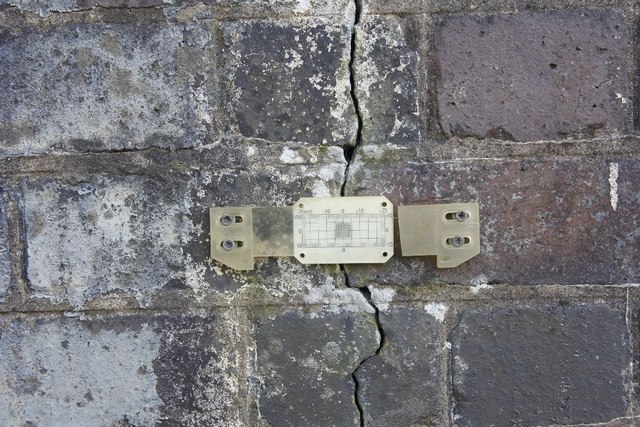
The Anns test lived as long as until Murphy v Brentwood [1991] where it was completely overturned.
Meanwhile the next and very lasting development in liability was the three stage test set out in Caparo v Dickman [1990], a test of foreseeability, proximity and reasonableness. Caparo concerned financial accounts which incorrectly stated the profits of a public limited company. An investor relied upon the accounts to their detriment and subsequently sued the accountant Dickman. It was ruled that as the accounts were not produced with the specific audience of any particular investor in mind there was a lack of sufficient proximity to make Dickman liable.
Indeed one of the key components of the judgement in Caparo was to protect against, in the words of the U.S. Supreme Court Judge Benjamin N. Cardozo ‘liability in an indeterminate amount for an indeterminate time to an indeterminate class.’ That would be simply too much; a flood of fatuous claims.

The Caparo stage 1) test of foreseeability is fairly clean cut. The effect of actions on the plaintiff is either foreseeable, or not. Stage 3), of reasonableness allows for the taking into account of special circumstances of the case which cannot be ignored. Stage 2), proximity, is of most interest, and is the subject of part II of this series, regarding what is referred to as the chain of causation, and the attribution of liability that arises.
References:
- Donoghue v Stevenson [1932] UKHL 100
- Anns v Merton London Borough Council [1978] AC 728
- Murphy v Brentwood District Council [1991] 1 AC 398
- Caparo Industries PLC v Dickman [1990] UKHL 2
- Ultramares Corporation v. Touche, 174 N.E. 441
Part II
Key developments in the law of liability in the 20th century came in the cases Donoghue v Stevenson [1932] , Anns v Merton LBC [1978], Murphy v Brentwood [1991] and Caparo v Dickman [1990]. In Caparo v Dickman a three stage test of foreseeableness, proximity, and reasonableness and fairness was set out in determining whether a duty of care arises.
Whether the damage caused was foreseeable is fairly straightforward to ascertain. The test of reasonableness and fairness exists to take into account any factors which may make it clearly unjust to impose a duty of care upon the defendant, or where ruling in favour of a duty of care would open the door to a myriad of fatuous cases.
The issue of proximity is usually of most importance, again returning to Lord Atkin in Donoghue v Stevenson [1932]:
“Who, then, in law, is my neighbour? The answer seems to be – persons who are so closely and directly affected by my act that I ought reasonably to have them in contemplation as being so affected when I am directing my mind to the acts or omissions which are called in question.”
And indeed, the courts do still use Donoghue as their fundamental point of reference in dealing with duty of care.
Two cases in the 21st century that have dealt with the question of proximity are Baxall v Sheard [2002] and Pearson v Charter [2007]. Both concern the culpability of architects in the underdesign of guttering systems.

In Baxall v Sheard [2002] there was a large warehouse with, effectively, two roofs with a valley gutter running down the length of the warehouse. The architects, Sheard, were commissioned and did the work around 1990 for a firm called Berisford. Baxall took a lease of the property in 1994.
There was no contract between Baxall and the architect, and therefore when the roof leaked on two separate occasions damaging their stock of electrical goods, Baxall sued Sheard in tort for negligence.
Baxall had employees and surveyors inspect the roof on several occasions, it had been suggested that debris was blocking the siphonic drainage system – even that seagulls nesting in the roof were the principal cause. It was not until after the second flood in 1995 that two contributing factors were identified: the siphonic drainage system had been underdesigned; that is, the bore of the pipes was too small for adequate drainage, and, crucially, there were not enough overflow outlets in the valley gutter. This lack of overflows meant that in the event the siphonic drainage did not drain all the water away, it would simply build up in the gutter, until it overflowed into the warehouse below.
Going back to first principles, one of the key features of Donoghue was that the snail was concealed, that is, it was not possible for the consumer to identify its presence: indeed Lord Atkin:

“I draw particular attention to the fact that Lord Esher emphasizes the necessity of goods having to be “used immediately” and “used at once before a reasonable opportunity of inspection.” This is obviously to exclude the possibility of goods having their condition altered by lapse of time, and to call attention to the proximate relationship, which may be too remote where inspection even of the person using, certainly of an intermediate person, may reasonably be interposed.”
Out of this arises the concept of the chain of causation. The question is whether intermediate opportunity to discover the defect breaks the chain of causation and negatives the duty of care owed to the claimant. Steel J in Baxall [2002]:
“Actual knowledge of the defect, or alternatively a reasonable opportunity for inspection that would unearth the defect, will usually negative the duty of care or at least break the chain of causation unless(as is not suggested in the present case) it is reasonable for the claimant not to remove the danger posed by the defect and to run the risk of injury:…”
In law, a defect is patent if it can be reasonably found on inspection, and latent if not so. “The concept of a latent defect is not a difficult one. It means a concealed flaw,” again in the words of Steel J in Baxall [2002].
In the first case in Baxall v Sheard [2000] the facts were that in the first flood the siphonic drainage system had been partially blocked, but in the second flood it was fully operational. Bowsher J Q.C. ruled that therefore the cause of the first flood was the lack of overflows, a patent defect, and that the cause of the second flood was the siphonic drainage, a latent defect. This would have had the consequence that the chain of causation was broken for the first flood, but remained intact, making the architects liable for the damage of the second flood.
Then, on appeal in Baxall [2002] the Court of Appeal agreed unanimously with Steel J in his conclusion that the lack of overflows were instead responsible for both floods. His argument turns mainly upon the idea that the overflows were intended to drain excess water not only in the case of rainfall exceeding the intended capacity of the siphonic drainage, but also in the case of impairment such as blockage:
“Put another way, the overflows were supplementary to the design capacity of the system. Their purpose was to provide relief both in the event that the gutter became blocked and in the event that the rainfall exceeded the design capacity. There were no less than two occasions when the absence of overflows ought to have been appreciated: first at the time of the pre-purchase survey and second in the aftermath of the first flood. If the deficiency had been realised, the remedial measures would have been taken, none of which involved re-design save in the sense of installing additional drainage capacity. Thus, in my judgment, the sole effective cause of both floods was the absence of overflows.”
Thus as both floods were caused by the patent defect of missing overflows, with sufficient opportunity to identify this defect, in Baxall [2002] the chain of causation was broken and the architect was liable for neither of the two floods.

Pearson v Charter [2007] shared almost exactly the same setting as in Baxall. A warehouse with a valley gutter was flooded, this time entirely due to an underdesigned siphonic drainage system. Damages of £2.1 were sought by the plaintiff. The claimant was one in a long line of companies that had been assigned the lease of the building, and therefore, like in Baxall, no contract existed between them and the architect, as a result, they sought a result under the tort of negligence under Donoghue v Stevenson principles, and relying upon the chain of causation remaining intact.
What brought the claim at all into question was that a company that had preceded Pearson Education as tenants had already experienced a serious flood. They were insured, and their insurers had instructed their loss adjusters to identify the cause of the flood, and the consequence was a finding that the capacity of the drainage system was too low. Crucially, this was never communicated to the tenant. The question that arose is whether the untold discovery of the flaw by a third party broke the chain of causation and absolved the architect of lability.
In the High Court His Honour Judge Thornton found that the architects were liable to Pearson, and that the finding of the flaw by a third party did not break the chain of causation. He took a rather methodical view, identifying a list of ten conditions that had to be fulfilled in order for liability to arise. One of these conditions was inevitably whether a duty of care arose, and it was found that in the law, the silent finding of a defect by one of a class of potential claimants does not necessarily negative the duty of care owed by the manufacturer to other members of that class. Consequently HHJ Thornton held that the chain of causation remained intact and a duty of care was owed by the architects to the claimants. .
The case then made its way to the Court of Appeal where the court unanimously agreed with the judgment of Lord Phillips of Worth Matravers, CJ; that the architects were indeed liable, and that the untold discovery of a latent defect need not remove its latency. Lord Phillips:
“We can see no basis of principle or authority why the fact that a third party becomes aware of a latent defect should be deemed to make the defect patent to others who neither know, nor ought to know, of the discovery.”

Lord Phillips also makes reference to a variety of comments suggesting the relevance of contributory negligence to cases of this kind, in particular McIlveen v Charlesworth Developments [1982] and Nitrigin Eireann v Inco Alloys Ltd [1992]. Thus he raises the question of whether, within the framework of a ‘chain’ system for liability, a party who is responsible for inspecting a product should simply become contributorily negligent if they fail to expose a flaw that they should have exposed.
Lord Phillips comments that he ‘had some difficulty in understanding’ some of the reasoning in Baxall. He finishes with the suggestion that the law in Baxall that defects being patent extinguish the liability of the maker may be too soft on manufacturers. Under Young v Bristol [1944] the Court of Appeal cannot overturn its own decision in Baxall except in special circumstances*, and so Lord Phillips closes the section by commenting that the decision in Baxall may, with the correct case, be overturned by the House of Lords. He overturns the appeal in Pearson v Charter to hold that the architects’ duty of care to Pearson was not negatived:
“It may be that, in an appropriate case, Baxall will receive consideration by the House of Lords. For the reasons that we have given, on the facts of the present case it affords [Charter] no defence to [Pearson’s] claim and we reject the grounds of appeal that have given rise to the first issue.”
The limitation issues of this case were also resolved to find Charter wholly liable.
The comments of Lord Phillips on adopting a contributory negligence stance instead of a causative approach, to dish out liability when there is a chain of parties who could be held responsible, are no doubt an attempt to modernise an area of law that still has Donoghue v Stevenson [1932] as its basis. In the next part of this series we will examine the recent case Begum v Maran [2021], where a claimed duty of care owed by the privileged to the very unfortunate brings long standing norms of corporate responsibility into question.
* Under Young v Bristol Aeroplane Co Ltd [1944] the Court of Appeal (CA) must follow precedents that have been set before it previously except in certain circumstances. Indeed Lord Cozens-Hardy M.R. in Velasquez, Ld. v. Inland Revenue Commissioners [1914]:
“If it is contended that the decision is wrong, then the proper course is to go to the ultimate tribunal, the House of Lords, who have power to settle the law and hold that the decision which is binding upon us is not good law.”
Lord Greene M.R. in Young v Bristol sets out the rights of the Court of Appeal (CA) in deviating from previous decisions:
“(1.) The court is entitled and bound to decide which of two conflicting decisions of its own it will follow.
(2.) The court is bound to refuse to follow a decision of its own which, though not expressly overruled, cannot, in its opinion, stand with a decision of the House of Lords.
(3.) The court is not bound to follow a decision of its own if it is satisfied that the decision was given per incuriam.”
per incuriam meaning that some crucial piece of law was overlooked or not brought before the court when the previous decision was made. There are some additional circumstances where deviation from previous decisions is deemed appropriate that have come about since Young v Bristol [1944]; but we do not concern ourselves with them here.
Cases:
- Donoghue v Stevenson [1932] UKHL 100
- Murphy v Brentwood District Council [1991] UKHL 2, [1991] 1 AC 398
- Anns v Merton London Borough Council [1977] UKHL 4
- Caparo Industries pIc v Dickman [1990] 2 AC 605
- Baxall Securities Ltd v Sheard Walshaw Partnership [2000] EWHC Technology 53
- Baxall Securities Ltd v Sheard Walshaw Partnership [2002] EWCA Civ 09
- Pearson Education Ltd v Charter Partnership Ltd [2005] EWHC 2021 (TCC), [2006] PNLR 14
- Pearson Education Ltd v Charter Partnership Ltd [2007] EWCA Civ 130, [2007] All ER D 262 Feb
- Young v. Bristol Aeroplane Co Ltd [1944] KB 718 CA
- McIlveen v Charlesworth Developments [1982] NI 216
- Nitrigin Eireann v Inco Alloys Ltd [1992] 1 WLR 498.
- Pearson v Charter [2007] EWCA Civ 130
- Begum v Maran (UK) Ltd [2021] EWCA Civ 326
- Velasquez, Ld. v. Inland Revenue Commissioners [1914] 3 KB 458
Part 3
The question of proximity is not one confined to the law of liability in the case of defective manufacture or construction. The case Hinz v Berry [1970] of Lord Denning M.R. otherwise known as ‘The Bluebell Case’, involved a woman Mrs. Hinz, who left her husband and seven of her children in a layby, while she crossed the road with one child to pick bluebells on the other side. Next she saw her husband and the seven children run down by a car. Her husband was killed and the children were severely injured, and she sued the driver, representing her children in the action as well as herself, in tort. The judge, assumedly at the High Court, found the figure of £15,000 to be appropriate to cover the loss of income resulting from Mr Hinz’ death. Sums of money were paid in regard to the childrens’ injuries.

Two years after the accident it was a medical conclusion that Mrs. Hinz was suffering from clinical depression, and this state persisted in the four years following up to the appeal case. The question therefore arose of compensation for nervous shock; that is; actual psychiatric illness brought on by an event. Lord Denning:
“In English law no damages are awarded for grief or sorrow caused by a person’s death. No damages are to be given for the worry about the children, or for the financial strain or stress…”
The problem is then how to separate out the usual grief and sorrow in losing a loved one from the suffering then extending to psychiatric illness caused by presence at the distressing event. Again, Lord Denning:
“The way to do this is to estimate how much Mrs. Hinz would have suffered if, for instance, her husband had been killed in an accident when she was 50 miles away: and compare it with what she is now, having suffered all the shock due to being present at the accident.”
It is added that in the event Mrs. Hinz had not been directly proximate to her husband’s death in this way she would have recovered in due course:
“Mrs. Hinz was not predisposed at all. She was a woman of great capacity, level-headed, hard working, happily married. She would have got over the loss of her husband in, say, a year.”
Indeed, qualifying the distinction between a death in more ordinary circumstances and what Mrs. Hinz witnessed was made clear by a previous judge, probably at the High Court:
“I am satisfied that she was of so robust a character that she would have stood up to that situation, that she would have been hurt, sorrowful, in mourning, Yes; but in a state of morbid depression, No.”

Mrs. Hinz had been awarded £4000 for nervous shock, which the defendant protested was too large a sum. Lord Denning at the Court of Appeal upheld the judgment:
“We can only interfere if it is a wholly erroneous estimate. I do not think it is erroneous.”
Another series of cases that explored proximity followed the Hillsborough Disaster of 1989 when 97 people were killed in a crush as spectators entered the Hillsborough stadium in Sheffield for an FA-Cup semi final.
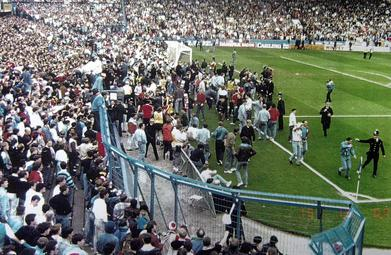
In Alcock v Chief Constable of South Yorkshire Police [1992], families of victims who watched the events on television or heard them on the radio were held not to be proximal, and therefore were denied damages for their ordeals. It was much to their anger when, in Frost and Others v Chief Constable of South Yorkshire and Others [1996], police officers present at the match were awarded significant damages as they had attempted to manage the situation, the Police being partly to blame for the disaster. This decision was overturned 4:1 in the appeal White and Others v Chief Constable of the South Yorkshire Police [1998].
Despite a protracted series of inquiries, coroners hearings and cases in tort, Lord Hoffman managed to refine a set of circumstances under which compensation for nervous shock could be awarded to family members of the victims in his opinion in White and Others v Chief Constable of the South Yorkshire Police [1998]:
“(1) The plaintiff must have close ties of love and affection with the victim. Such ties may be presumed in some cases (e.g. spouses, parent and child) but must otherwise be established by evidence.
(2) The plaintiff must have been present at the accident or its immediate aftermath.
(3) The psychiatric injury must have been caused by direct perception of the accident or its immediate aftermath and not upon hearing about it from someone else.”
Lord Hoffman’s opinion was indeed the most forthright of the five justices and is worth quoting at length:
“The position which the law has reached as a result of Alcock v. Chief Constable of South Yorkshire [1992] 1 A.C. 310 has not won universal approval. The control mechanisms [tests for liability arising] have been criticised as drawing distinctions which the ordinary man would find hard to understand. Jane Stapleton has said that a mother who suffers psychiatric injury after finding her child’s mangled body in a mortuary “might wonder why the law rules her child’s blood too dry to found an action”: see The Frontiers of Liability ed. Peter Birks, O.U.P. (1994) Volume 2, p. 84. Equally, the spectacle of a plaintiff, who has, ex hypothesi, suffered psychiatric illness in consequence of his brother’s death or injury, being cross-examined on the closeness of their ties of love and affection and then perhaps contradicted by the evidence of a private investigator, might not be to everyone’s taste: see the Law Commission Report on Liability for Psychiatric Illness (Law Com. No. 249) at para. 6.24).”
“… if one starts from the imperfect reality of the way the law of torts actually works, in which the vast majority of cases of injury and disability, both physical and psychiatric, go uncompensated because the persons (if any) who caused the damage were not negligent, or because the plaintiff lacks the evidence or the resources to prove to a court that they were negligent, or because the potential defendants happen to have no money, then questions of distributive justice tend to intrude themselves. Why should X receive generous compensation for his injury when Y receives nothing? Is the administration of so arbitrary and imperfect a system of compensation worth the very considerable cost? On this view, a uniform refusal to provide compensation for psychiatric injury adds little to the existing stock of anomaly in the law of torts and at least provides a rule which is easy to understand and cheap to administer.”
Indeed a complete refusal to offer compensation to claimants on the basis of psychiatric consequences was available as an option in this series of cases, as was the polar opposite approach of offering all present at a disaster the opportunity to claim on the basis of psychiatric harm.
“…it is important to bear in mind, as I said earlier, that they [previous judgments] are not contemporaneous statements of the law but represent legal thinking at different points in half a century of uneven development.”
A key question is whether compensation for psychiatric injury should be extended to actors on the basis that they are ‘rescuers’ or employees (in the case of policemen):
“There is no authority which decides that a rescuer is in any special position in relation to liability for psychiatric injury…”
“Should then your Lordships take the incremental step of extending liability for psychiatric injury to “rescuers” (a class which would now require definition) who give assistance at or after some disaster without coming within the range of foreseeable physical injury? It may be said that this would encourage people to offer assistance. The category of secondary victims would be confined to “spectators and bystanders” who take no part in dealing with the incident or its aftermath. On the authorities, as it seems to me, your Lordships are free to take such a step.”
“In my opinion there are two reasons why your Lordships should not do so.”
Lord Hoffman’s reasons defy succinct summarisation, however, firstly:
“… the line between them and bystanders becomes difficult to draw with any precision.”
And, secondly:
“… the more important reason for not extending the law is that in my opinion the result would be quite unacceptable. I have used this word on a number of occasions and the time has come to explain what I mean. I do not mean that the burden of claims would be too great for the insurance market or the public funds… [the] “floodgates” argument.”
“But I think that such an extension would be unacceptable to the ordinary person because (though he might not put it this way) it would offend against his notions of distributive justice. He would think it unfair between one class of claimants and another, at best not treating like cases alike and, at worst, favouring the less deserving against the more deserving. He would think it wrong that policemen, even as part of a general class of persons who rendered assistance, should have the right to compensation for psychiatric injury out of public funds while the bereaved relatives are sent away with nothing.”
“[The question] is not whether a policeman should be disqualified in circumstances in which he would ordinarily have a right of action, but whether there should be liability to rescuers and helpers as a class. And in considering whether liability for psychiatric injury should be extended to such a class, I think it is legitimate to take into account the fact that, in the nature of things, many of its members will be from occupations in which they are trained and required to run such risks and which provide for appropriate benefits if they should suffer such injuries.”

“Naturally I feel great sympathy for the plaintiffs, as I do for all those whose lives were blighted by that day at Hillsborough. But I think that fairness demands that your Lordships should reject them.”
Three of the remaining four justices reached the same ultimate conclusion as Lord Hoffman.
Interestingly there is a law in a number of states in America known as the ‘fireman’s rule:’ “In terms of duty, it may be said there is none owed the fireman to exercise care so as not to require the special services for which he is trained and paid:” Krauth v. Israel Geller and Buckingham Homes, Inc. (1960). The rule often extends to other professional rescuers such as policemen. The reasoning at its most basic is that the dangers of the job are obvious. Over time the rule has sometimes been rejected by certain courts and it has been legislated against in some states. It has no basis in English law.
Cases:
- Hinz v Berry [1967 H. No. 95]
- Hinz v Berry [1970] 2 QB 40 CA
- Alcock v Chief Constable of South Yorkshire Police [1991] UKHL 5, [1992] 1 AC 310
- Frost and Others v Chief Constable of South Yorkshire and Others [1996] EWHC CA 173, [1997] 1 All ER 540
- White and Others v Chief Constable of the South Yorkshire Police [1998] UKHL, [1999] 2 AC 455.
- Krauth v. Israel Geller and Buckingham Homes, Inc.157 A.2d 129 (1960)
 Landed
Leave a comment